EXCERPT: LISA CARVER
My interview with Suckdog for the Whitney Review

HELLO!
Today, a pause from regular programming to give you all a brief glimpse into a recent epic interview I did for The Whitney Review, with LISA CARVER, the punk legend also known as Lisa Suckdog.
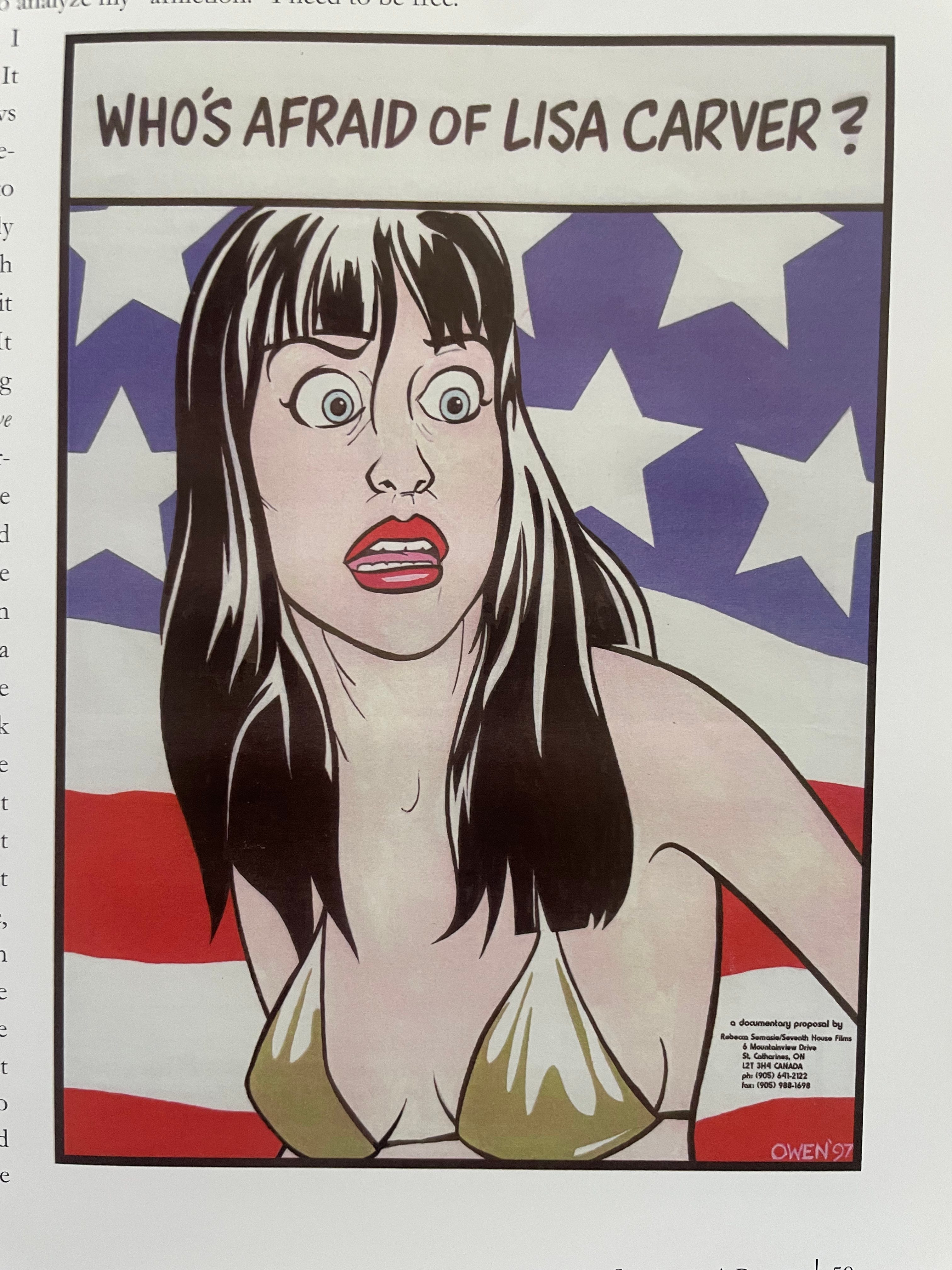
They say don’t meet your heroes, but in this case, we’ve actually met twice and it’s just gotten better each time. This was an interview that truly moved me. Or even, changed me. A cycle complete. La boucle est bouclée.
Read the full piece in the Spring/Summer 2026 issue of The Whitney Review—btw we’re on the COVER—(and follow The Whitney Review & former Love Buzz guest Whitney Mallett ) —also worth reading in it is mark iosifescu’s deep-dive review on the deep-dive William T. Vollmann CIA book, A Table for Fortune.
Also, I don’t think I’ve mentioned it here yet but Angels in America, my band with mark iosifescu, released our first album in a while last week. It’s called Asphalt Green.
And you can listen to it just about anywhere thanks to Halcyon Veil.

ESRA PADGETT: Do you want to start by introducing yourself?
LISA CARVER: I’m Lisa Carver.
EP: What’s your, like, self-description if you had to give one?
LC: No one’s ever asked me how I would describe myself. I really… wouldn’t? I don’t think any writer would describe themself, because they’re so concerned with what they’re describing.
EP: [Laughs.] I am someone who writes about other people, I have that feeling where I’m like, “It’s not about me.”
LC: I write about myself constantly, and I have for 40 years, but it’s never about me. When I write about me, I’m writing about what I would be in that moment with that person, on that day, in that place—if I were a person, you know? It’s like I’m spying on the humans through myself. I know I’m a person. But my relationship with the world is one where I am kind of floating.
EP: I love that about your writing. We actually met once.
LC: I thought you looked familiar!
EP: I went to your show in Oakland years ago. I bought this and you signed it. It says: “To Ezra, you’re really beautiful. I always say that, but this time, it’s really true.”
LC: [Laughs.] Don’t let the other people hear that!
EP: That voice that you’ve developed over so many years, it’s very girl-coded. Rereading all this stuff, like the writings in Rollerderby—it feels so contemporary and current. Now the internet is filled with girls who auto-describe in a way that’s similar. I don’t know if that’s in your awareness at all. And not to say that they’re ripping you off. But I imagine, when you started, that your voice was very singular.
LC: Yeah, I didn’t know anybody writing, or being, like me. I write to women. I write to girls. I don’t write to men. If they want to read it, it’s okay, but I don’t care about them. I mean, I fall in love with them. But I don’t care if they read what I write. I don’t care if they like it, I don’t care if they relate to it. Because they have the money, women think that we have to write to them. But I don’t need money. Anyway, the less you care about them, the more money they give you. [Laughs.] When I look at TikTok, I see so many women who even say, “This is to the girlies.” I just love it. It’s probably part of why I left my husband, because all these other women were like, “You don’t need that garbage.”
EP: I work in the porn industry and the sex industry, and I recently did this interview with this big OnlyFans star named Ari Kytsya. Her brand and her voice is kind of like, “I’m super hot, but I’m also gross and disgusting. I’m funny and I’m sexy.” That, to me, is so much in your writing. In one of your books, there’s something you wrote about growing up: “We hid in our closets to do disgusting things like masturbate with a pine cone or chew the boobs off Barbie.”
LC: [Laughs.] Now we’re out of the closet!
EP: Your writings embodied that persona in the ’90s, and these girls on TikTok that are doing the same thing now, talking about the way their pussy smells or whatever.
LC: There’s just a joy in discovering that you can be a funny little monkey. And the patriarchy still tells you you can’t, but it rewards you for being yourself. It’s such a pleasure to realize you’re good enough. You don’t have to aspire.
EP: I feel like a big theme in your work is girl muses. Are your friendships with other women, like, muse relationships?
LC: No, we just encourage each other. We don’t inspire each other. I think men use women as muses, but women, we collaborate. With muses, the man takes over the woman. With girlfriends, we tell each other our crazy ideas and then we say, “Yes, that’s a really good idea,” even though it’s not. You say, “That’s great, do it.”
EP: A couple of seasons ago on Love Island, there was this amazing triangle of girlfriends. There’s a quote from one of them that was like, “I support women’s rights and women’s wrongs.”
LC: [Laughs.] I love it! Oh, that’s great.
EP: That kind of partnership that you’ve had with girlfriends in your life is such a powerful throughline. Are you still in touch with people? Are there new relationships in your life that offer that same thing?
LC: Yep. I keep the old ones, and I just keep on adding. Unless they die, but I still think about them.
EP: What about in your work right now?
LC: My writing has changed. It’s more philosophical. I’m not interested in romance. My last marriage was so awful, and I don’t have any estrogen left. That’s the main thing that writing was for me: getting over these things that took my breath. I couldn’t breathe in my love affairs, yet I couldn’t escape them, either. I needed women and animals to breathe.
Now, I’m breathing. And also, I’m 57 and I had cancer. I had a lot of pain and exhaustion, which is totally new for me. I was healthy as a stick, and then all of a sudden, I’m really sick. I’ve always thought about death, but I thought of it almost like a lover. And now I think of it as an end—mainly an end to suffering, but also an end to this life. Not thinking of myself as human was really cool for thinking I would never die. Because if I’m not alive, how can I die? Now I know I’m alive because you couldn’t hurt this bad if you weren’t alive. I think about what I want to say, who I want to spend time with. Before, everything was equal to me. Every chair was the best chair in the theater. Now, I’m like, “No, I only have a few chairs left. So they’ve got to be good.” I mean, they don’t have to be good, but I have to choose them.
EP: That’s a beautiful evolution, even though it sounds like it came to you through difficulty.
LC: Yeah. What I really care about is being interested in whatever is happening. And I am interested in aging. Most of my friends are around my age, so they’re all getting diseases. It’s terrible. You realize how precious your body is. My bones, my cells, they’ve all become lovable to me.
EP: You said you’re not interested in romance anymore, but it sounds like you’re still very much interested in love.
LC: I am very interested in love. Romance was never about love for me. I don’t think I loved any of these guys. I think I hated them. I think they hated me!
Read more The Whitney Review